


Introduction
In Belgium, close to 60% of new passenger cars sold are company cars. An important share of these company cars can also be used free of charge for private purposes. Such cars constitute a benefit in kind (BIK): for the beneficiary, it is as if he would receive extra pay, but with the obligation to spend that extra money on a car.
It has long been argued that the widespread use of company cars in Belgium leads to significant budgetary shortfalls compared to a benchmark where they would be taxed in the same way as money wages. Existing estimates of lost revenue for the government (including social security) run from about 2 to 4 billion. There is thus a wide margin in these estimates, even if all authors agree on the order of magnitude.
In a recent paper, the Belgian Federal Planning Bureau has updated these estimates. The analysis confirms the order of magnitude of the existing estimates, but the sensitivity analysis shows that uncertainty remains high.
Sources of tax expenditures
The most widely discussed source of tax expenditures is that the tax base for the personal income tax and the contributions to social security are disconnected from the real value of the company car to the user. Indeed, for personal income tax purposes, the benefit in kind (BIK) is calculated as a function of the car’s list price and age, its powertrain, and the difference between its CO2 emissions and the average emissions of cars sold in Belgium in the past year. Company cars are completely exempt from employee contributions to social security, and employer contributions they incur depend only on the car’s fuel and CO2 emissions. Moreover, fuel and charge cards made available to the driver for private travel are not included at all in the calculation of the benefit in kind.
Another important issue is the recovery of VAT on the fixed (purchase) and the variable (fuel and electricity) costs of the company car. The fundamental principle underlying VAT is that it is only levied on the value added at each stage of the production and distribution of a product: at each intermediate step, the business can recover the VAT it paid to its suppliers. Following this logic, when a company car is used partly for private purposes, only the VAT expenses related to the professional use of the car should be recoverable. In Belgium, three different approaches exist to calculate the recoverable share of VAT. First, the user of the company car can opt for a detailed bookkeeping of his professional use of the company car, and then the recoverable share of VAT is proportional to the professional use of the company car. Second, to reduce the administrative burden for companies, the recoverable share can also be calculated as a function of the commuting distance for the car user instead – note that commuting is not considered professional travel in Belgian tax legislation. Third, if the employer does not opt for either of the two previous systems, the tax authorities will use 0.35 as the default value for the proportion of professional travel. Except in the first case, this means that the actual recovery rate will not correspond to the actual share of professional travel – which, according to the most recent national travel surveys, lies below 10%.
Approach
In the first step, we have compared, for each company car, the tax revenue in the existing legislation with the revenue in a benchmark in which the benefit in kind is assimilated to the cost of the private use of the car for the beneficiary if he had to pay for this private use himself. To be more concrete, income taxes and social security contributions are levied on the total cost of ownership, and the amount of VAT that can be recovered is strictly proportional to the professional use of the car. We use the term “tax expenditures” to refer to the difference between tax receipts in the current tax system and the hypothetical receipts in the benchmark.
This transition to the benchmark system does not only mean a change in receipts of taxes levied on company cars: the current method of calculating the benefit in kind and the solidarity contribution provides incentives to reduce CO2 emissions. In the benchmark, we remove these incentives and expect a decrease in the number of cars with a low CO2 emission factor.
To calculate behavioural effects, we use the CASMO model, an econometric model of the Belgian car stock. CASMO calculates the impact of factors like taxation on fleet composition, both for private and company cars.
Key results
Fig 1. Projections of the market share of new company cars in 2028 (%)
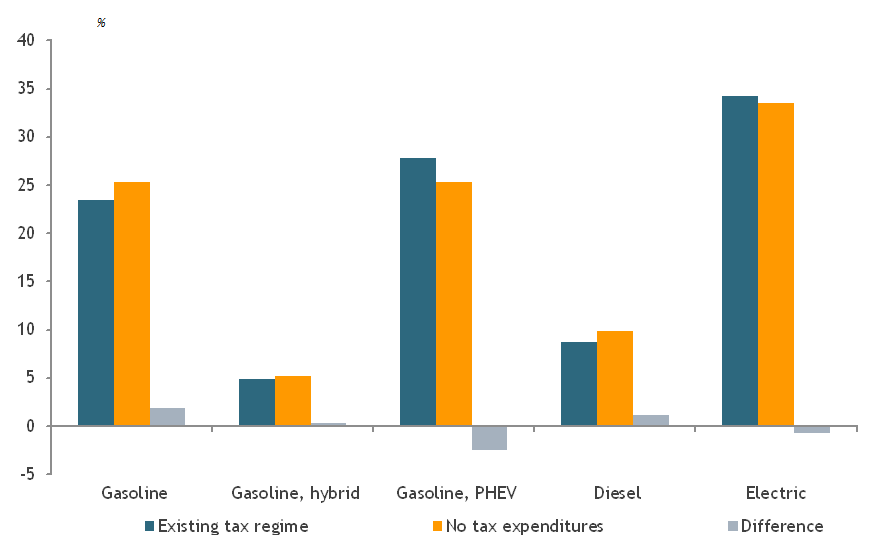
Since most of the taxes we consider here depend mainly on the composition of the fleet, and since the fleet will only gradually adapt to changes in purchasing behaviour, we represent the effects in 2028.
In the benchmark scenario, we assume that a car first purchased by a private household is sold on the second-hand market after 6 years and depreciates annually by 25%. Compared to the reference scenario, by 2028, the market share of gasoline PHEVs decreases from 27.8% to 25.6%, and that of electric cars decreases from 34.2% to 33.5% while the market share of all the other powertrains increases only marginally. All by all, such a hypothetical reform would lead to only a modest slowing down of the greening of the company car fleet in Belgium – as we argue in the section on the environmental impact of company cars, this greening is driven mostly by incentives provided in corporate taxation.
Fig 2. Tax revenues linked to the private use of the company cars in 2028 per powertrain (Million euro)
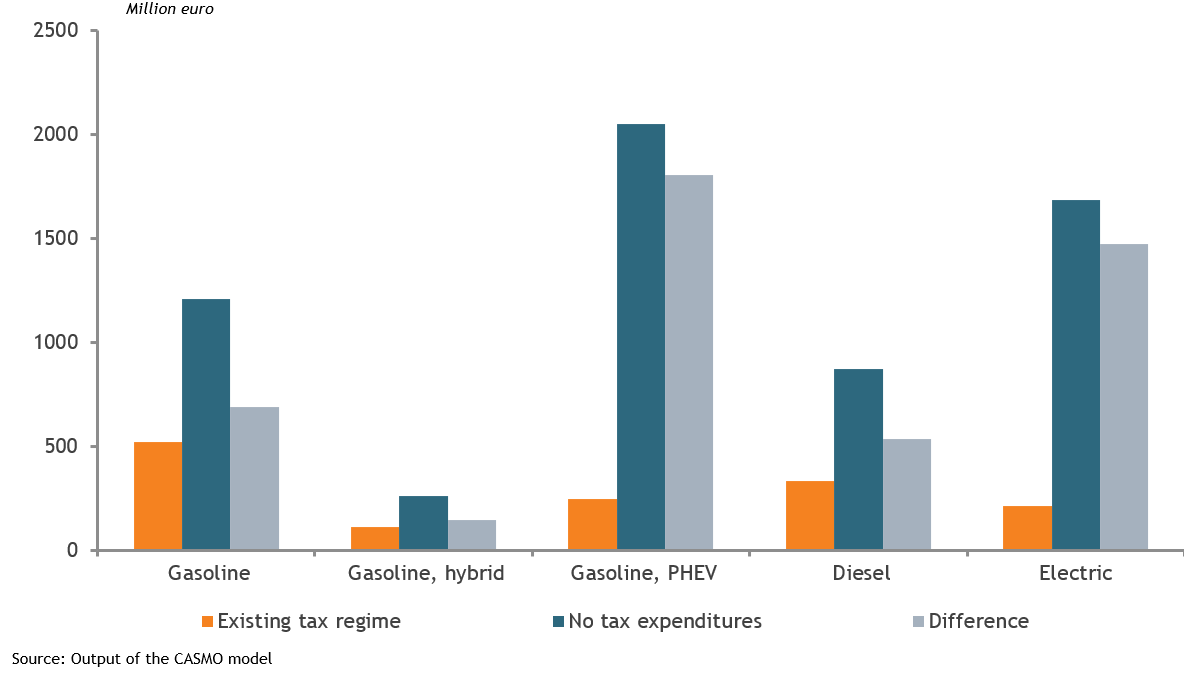
By 2028, the difference between tax receipts under the benchmark and the current tax regime reaches just over 5.2 billion EUR. The move from the existing tax rules to the benchmark rules leads to an increase in tax receipts from all powertrains. However, this increase is much larger for electric cars and for gasoline PHEVs. The recent sharp increase in the electrification of company car fleets explains why this difference is somewhat higher than in earlier estimates by the OECD (Harding, 2014) and the European Commission (Princen, 2017).
Sensitivity analysis
Our analysis involved assumptions due to data limitations regarding factors like the residual value of company cars upon resale, the annual distance driven or the share of private kilometers in total annual trips. Our sensitivity analysis has shown that, under alternative assumptions for these parameters, total tax expenditures vary from slightly more than 3 to slightly more than 6 billion annually.
Behavioural effects that have not been simulated
There are several behavioural effects that we cannot calculate with the CASMO model: CASMO focuses on the composition of sales as a function of the technical features of cars, such as their powertrain or maximal power. The total number of company cars, annual distances travelled, and the share of private kilometres are determined exogenously.
However, if fuel and charge cards are taxed for private use, it seems plausible that the private use of company cars will decrease. By not including this effect, we overestimate the potential additional revenue if we tax private use of fuel and charge cards. Moreover, a less favourable tax and parafiscal treatment of company cars could undermine the attractiveness of the system to such an extent that companies are less likely to use the system. The net effects of such a behavioural change are difficult to estimate, as we then also would need to consider labour market effects: if fewer company cars are offered as in-kind benefits, employees will expect higher gross wages as compensation, which would subsequently lead to higher tax revenues.
The evolving issue of the environmental impact of company cars
The environmental impact of company cars has often been central to policy debates. On the one hand, households with a company car own more cars, undertake more trips, have longer commutes and use public transport less often. Company cars also tend to be heavier than privately owned cars. On the other hand, as company car fleets are renewed quickly, company cars tend to comply with the most recent emission standards.
But, as Harding (2014) has pointed out, the links between car characteristics and environmental harm are not always straightforward. For instance, new vehicles tend to be more fuel efficient than old ones, all other things (weight, maximum power, etc) being equal. However, if company cars are heavier and more powerful than privately purchased ones, “other things” are definitely not equal. Harding (2014) has therefore emphasized that an assessment of the environmental impact of company cars requires q study of how tax settings affect all the elements that determine a company car’s environmental impact, including the travel behaviour of households that have access to a company car.
In Belgium, car taxation has increasingly been designed to reflect environmental concerns. First, since 2007, the deductibility of car related costs in corporate taxation depends on the car’s CO2 emissions, and the parameters have gradually become more stringent through time. Second, the benefit in kind linked to the private use of company cars used to be taxed according to the taxable horsepower of the car. Since January 2012, the taxation of the benefit in kind depends on a car’s catalogue value and its CO2 emissions. Third, excise taxes for diesel cars have increased (also for privately owned cars), and, in Flanders, the registration tax and annual road tax now also reflect a car’s Euro emission class, powertrain and CO2 emissions (except for leased company cars). As a result, the share of diesel cars in the company car stock has decreased from 88 % in 2012 to 38 % in 2021. This decrease in the share of diesel cars was essentially mainly driven by an increase in the share of gasoline cars (which tend to have higher CO2 emissions, all other things being equal), but the share of electric cars and gasoline PHEV has increased rapidly in recent years.
Moreover, the “Law on fiscal and social greening of mobility” of 25 November 2021 entails a drastic overhaul of two elements that affect the “after tax” cost of company cars. First, as from 2026, the deductibility of car expenses in corporate taxation will be reduced to zero except for electric cars. Moreover, even for electric cars, the deductibility will gradually decrease through time from 100 % in 2026 to 38% after 2030. Second, the solidarity contribution for social security levied on company cars will increase sharply, with up to a factor 5.5 in 2026.
As a result, in 2024, 28% of new passenger cars registered in Belgium were fully electric cars, a market share that is almost entirely attributable to company cars (Wappelhorst, 2025).
The environmental impact of company cars has thus completely changed compared to a decade ago, when diesel cars dominated the composition of the company car stock. Moreover, in our evaluation of the “Law on fiscal and social greening of mobility” of 25 November 2021, we have shown that abolishing the deductibility of car expenses in corporate taxation (except for electric cars) would have a very large impact on the demand for electric cars (Franckx 2022). This stands in contrast with the modest impact on the share of electric cars that would result from abolishing the tax expenditures in personal income taxation. In other words, the greening of the company car stock has a clear impact on the total tax expenditures linked to company cars, but the incentives in personal income taxation have not been the driving force behind the greening.