

Governments often tax small business income at lower rates than employment income. The rationale is often that entrepreneurship generates positive spillovers in terms of innovation, investment, and employment. At the same time small business income may be harder to tax effectively than employment income, as small business owners may reduce effort or report less income in response to higher rates. Preferential tax treatment is often seen as a way of encouraging entrepreneurial activity and minimising distortions associated with taxation.
But do lower taxes for the self-employed merely create incentives for workers to switch their employment status rather than create genuinely new businesses?
In new research using administrative tax data from Poland, we study how high-income taxpayers responded to a major reform that significantly lowered taxes on self-employment income while leaving employment taxation unchanged. We find that the reform led to a substantial and persistent increase in self-employment among top earners. However, much of the response appears to have reflected income reclassification rather than genuine entrepreneurship.
Tax reforms that changed the taxes on self-employment relative to employment
In 2004, Poland introduced a 19% flat tax rate for owners of unincorporated businesses, including sole proprietors and partnerships. Self-employed taxpayers could choose between this flat rate and the regular progressive tax schedule, while employees, continued to face a progressive tax schedule with marginal rates reaching up to 40%. This created a large tax advantage for self-employment – especially at the top of the income distribution.
The reform offers a useful setting for studying responses by taxpayers because the taxation of self-employment fell significantly, while the taxation of employees remained unchanged. A second reform in 2009 narrowed this differential by flattening the progressive personal income tax schedule and reducing the top marginal rate from 40% to 32%. Figure 1 shows that, for the top percentile, average tax rates (ATRs) dropped sharply in 2004 for the self-employed. In 2009, on the other hand, ATRs fell for the top percentiles of employees.
We estimate responses using a difference-in-differences approach and population-wide administrative tax data covering all Polish taxpayers between 2000 and 2014. We compare individuals near the very top of the income distribution – who experienced the largest increase in incentives to become self-employed – with slightly lower-income taxpayers whose incentives changed much less.
Figure 1. Average tax rates (ATRs) employees and the self-employed over time
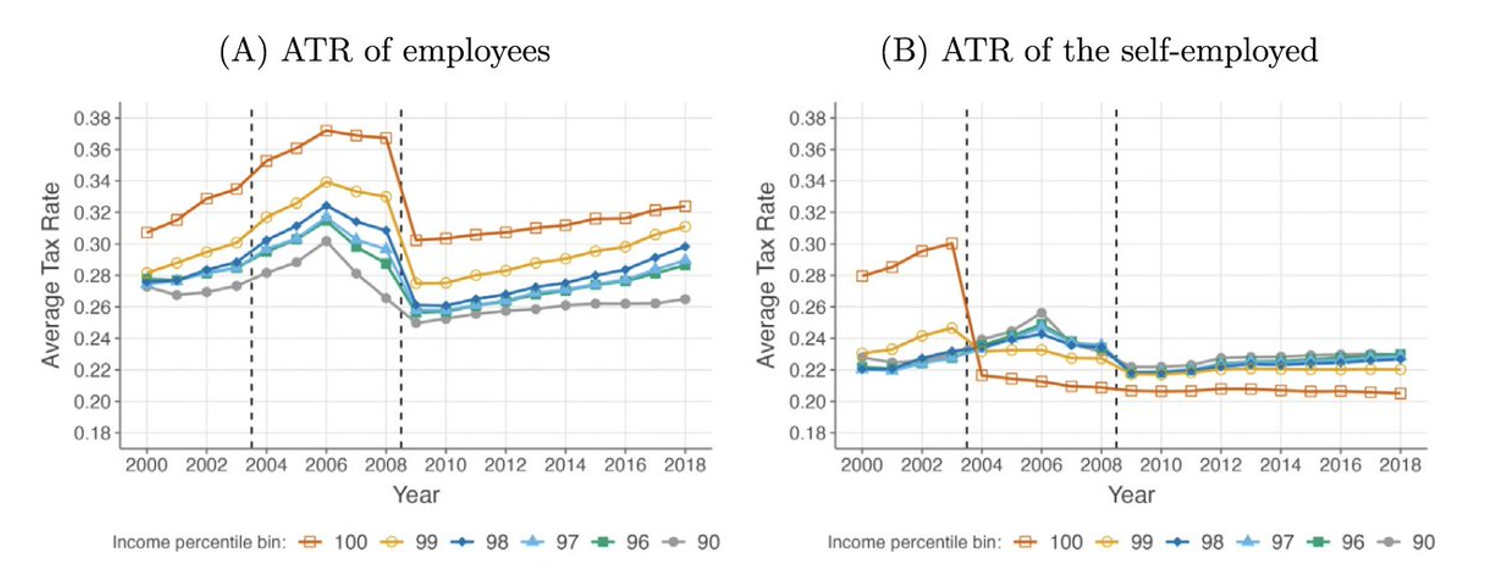
Note: Average Tax Rate represents the sum of an individual’s tax liability, health insurance, and social security contributions relative to their income before any deductions. The dashed vertical lines mark the 2004 flat tax reform (a large increase in the tax differential) and the 2009 reform of the progressive schedule (a reduction in the tax differential).
Large and persistent responses at the top
The results show strong behavioural responses among high-income earners.
Five years after the 2004 reform, the share of self-employed individuals in the top two percentiles of the income distribution had increased by 1.8 percentage points. This represents a 3.6% relative increase compared to the share which would have been observed without the tax changes. The estimates imply that a 1 percentage point increase in the tax differential between employment and self-employment increased the share of self-employed by roughly 0.9%.
Importantly, the response was driven by changes in transitions between employment and self-employment, which were persistent and accumulated over time. As can be seen in Figure 2, the reform generated a continuing increase in transitions from employment into self-employment, rather than a one-off adjustment. By contrast, after the 2009 reform reduced the tax advantage associated with self-employment, entries into self-employment fell, but there was little evidence of large-scale movement back into employment. (The downward trend over time is a mechanical result of starting from a sample were all individuals are initially employed.)
This asymmetry suggests that once individuals reorganise their affairs around self-employment, they may be reluctant to reverse the decision – potentially because of sunk costs, contractual arrangements, or the flexibility associated with the new status, or simply because a gap between the tax rates remained, leaving them with no financial incentive to move back.
Figure 2. Transitions from employment into self-employment – yearly averages (Panel A), and difference-in-differences estimates (Panel B)
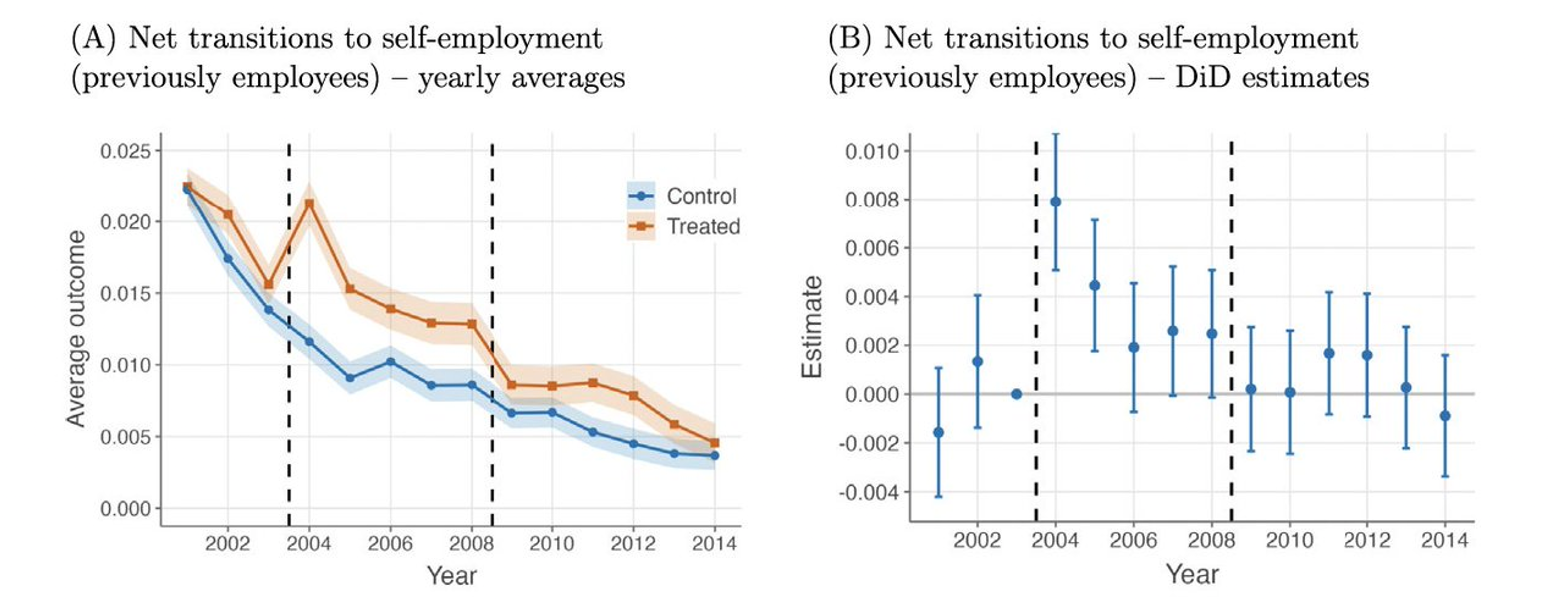
Note: Panel (A) shows the sample averages of net transitions to self-employment (defined as entries minus exits) for a balanced panel of individuals who were employees in 2000. Panel (B) shows Difference-in-Differences (DiD) estimates over time along with the 95% confidence intervals. The “Treated” group comprises taxpayers in the top two percentiles of the 2000 income distribution, while the “Control” group consists of taxpayers in the next two percentiles (97th and 98th).
Entrepreneurship or income reclassification?
A key policy question is whether these transitions reflected genuinely new entrepreneurial activity. The evidence suggests caution.
Most of the increases in self-employment occurred in sectors with a strong human-capital component, including finance, IT, professional services, and healthcare. These are precisely the sectors where highly skilled workers may find it relatively easy to provide services for similar work through self-employment arrangements.
Moreover, most of the new self-employed did not become employers. Around 60% of individuals who entered self-employment following the reform remained solo self-employed seven years later, without either hiring workers or becoming partners in larger firms. Only around 20% became employers or co-owners of businesses employing others, while the remainder exited self-employment altogether.
The reform therefore appears to have encouraged many highly skilled professionals to merely switch employment status and report business income instead of labour income, rather than create businesses that created additional jobs. This distinction matters because the economic case for preferential taxation of business income often rests on the existence of positive spillovers from entrepreneurship. If switching is mostly driven by tax considerations without real economic gains, the case for preferential taxation of business income is more fragile.
Figure 3. Impact of the flat tax reform on self-employment entry rates by hiring status and sector of the business activity 7 years after the entry
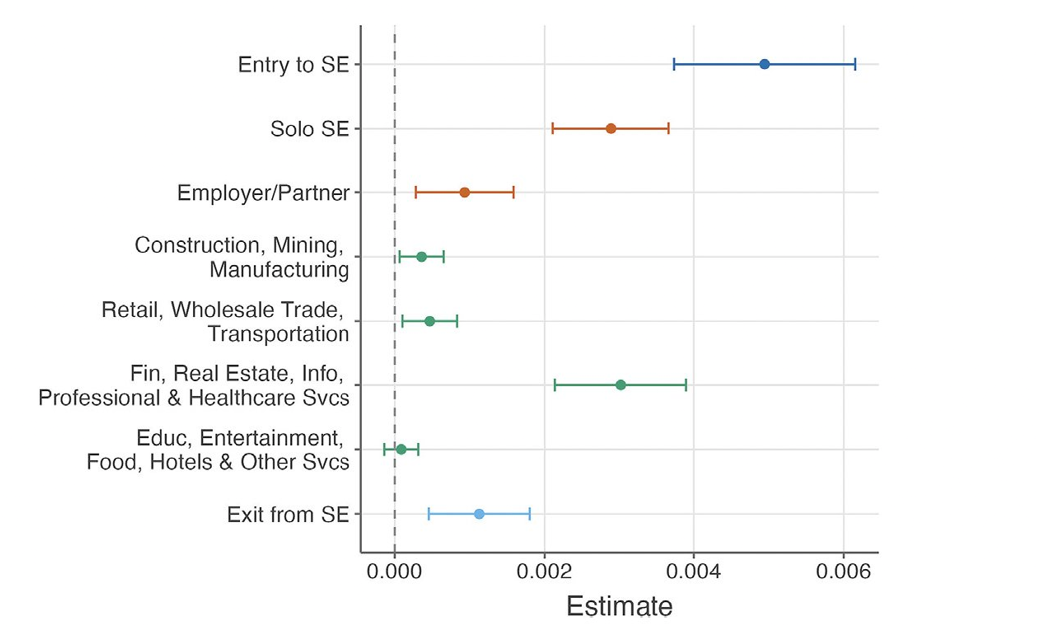
Note: This figure shows the average yearly effect of the 2004 flat tax reform on the probability of an employee entering self-employment. The overall entry rate is decomposed based on specific characteristics observed seven years after the initial transition, namely the long-term hiring status of the business and its sector of activity.
Implications for tax policy
Our results allow us to comprehensively assess the tax revenue implications of the 2004 reform. Absent any behavioural responses, the tax cut would have resulted in a mechanical 15.3% revenue loss among top earners (top 2 percentiles). Previous research shows that this mechanical loss was largely offset because lower rates encouraged existing business owners to report higher incomes (Kopczuk, 2024). We calculate that this intensive-margin response reduces the revenue loss from 15.3% to 3.5%. However, when we also account for the extensive-margin response – i.e. as high-income employees transitioned at higher rates into self-employment, while the self-employed transitioned at lower rates into employment – the revenue loss increases to 5.5%.
More broadly, the Polish case illustrates a broader challenge facing modern tax systems.
Preferential tax regimes targeted at small businesses can seem attractive and administratively simple to implement. Yet if large numbers of highly skilled workers can access them without meaningfully changing the nature of their economic activity, such policies need to be evaluated carefully, taking into account their full fiscal costs.
Recent research suggests considerable flexibility about whether income at the top of the income distribution is classified as employment or business income. Some have hypothesized that the increasing prevalence of business income at the top may be partly driven by tax-motivated reclassification (Smith et al., 2019, 2022; Delestre et al., 2024). Our paper supports this hypothesis.
In addition to losses of tax revenue, switching to self-employment for tax reasons has other implications.
It may mean less protection against labor market risk and lower social benefits, such as old-age and disability pensions, sickness benefits, and parental or paternity leave entitlements. This generates future public costs if individuals do not adequately self-insure.
In addition, such behaviour may raise equity concerns. Prevalence of business income at the top of the income distribution tends to reduce the effective progressivity of the income tax schedule (Förster et al., 2014; Rubolino and Waldenström, 2020). It may also undermine horizontal equity, as the ability to adjust organizational form in response to tax incentives may be much more restricted in certain sectors.