

This post draws on Hoy, C., Strehl-Pessina, M., Doino, R., Naidoo, D., Mambon, K. and Kunda, B. (2026), Who Benefits from Food Tax Exemptions in Lower-Income Settings? Evidence on Pass-Through and Incidence, World Bank Policy Research Working Paper 11453 (PDF). The research was supported by the World Bank Global Tax Program and the World Bank Pacific Observatory. The findings, interpretations and conclusions expressed here are those of the authors and do not necessarily reflect the views of the World Bank, its Executive Directors or the governments they represent.
Exempting basic foods from VAT is one of the most common tax expenditures in the world, justified almost everywhere as support for poorer households. New evidence from an unanticipated reform in Papua New Guinea shows that only 16 percent of the revenue forgone reached the poorest 40 percent of households, while the richest 40 percent as well as stores and wholesalers each captured close to 40 percent.
Governments almost everywhere exempt or zero-rate basic foods under their VAT, and the justification is nearly always the same: to lower the cost of living for poorer households. Whether that happens depends on two things that are rarely measured together in lower-income countries. Does the tax cut actually reach retail prices (i.e., pass-through)? And who buys the exempted goods, and where (i.e., incidence)?
Papua New Guinea gave us an unusually clean test to answer these questions. In a new World Bank working paper we track what happened to prices, and to whom the benefits flowed, after the country removed VAT from ten basic foods with less than two weeks’ notice. Eight cents of every dollar of forgone revenue reached the poorest fifth of households. More than a third was retained by stores and wholesalers rather than reaching consumers through lower prices.
For anyone assessing a VAT exemption on food, the result carries a simple lesson: identifying what poorer households eat is only the start. What matters is whether they buy it, where they buy it, and whether the seller passes the cut on.
An unanticipated reform, tracked from supermarket shelves to village stores
On 19 May 2025 the government of Papua New Guinea announced that from 1 June, twelve days later, ten food items would be zero-rated for VAT (known locally as GST), which had so far applied to them at 10 percent: rice, flour, cooking oil, tinned fish, tinned meat, chicken, noodles, biscuits, tea and coffee. It was the first time the country had exempted food from the tax. The stated aim was to ease cost-of-living pressures on poorer households. The expected cost was nearly USD 100 million a year in forgone revenue. With the exemptions scheduled to run for 19 months the government put the total at around USD 150 million.
The short notice limited opportunities for prices to change in advance. Six months later, around 97 percent of surveyed households still said they were not very familiar with the change. We compare prices of the exempt foods with those of similar non-exempt foods before and after 1 June, using four sources: monthly administrative price data collected since 2023 by the National Statistics Office and the central bank; a monthly price census of all 83 formal supermarkets in Port Moresby; weekly web-scraped prices from the two supermarket chains that sell online; and a monthly, nationally representative phone survey of around 1,000 households running since late 2023, which records what households buy, how much they pay, and whether they bought it in a formal supermarket or an informal store. Combining the price effects for each type of store and area with each household’s purchases gives the share of the forgone revenue that reached each consumption quintile, with the part never passed on assigned to stores and wholesalers.
Pass-through depended on where people shop
In the formal supermarkets of central Port Moresby, where retail competition is strong, the tax cut was passed through to prices in full, and it stayed that way. Where competition between formal stores was weaker, pass-through started at around two-thirds and was still incomplete four months after the reform. The pattern held even within a single chain: branches in central Port Moresby cut prices far more than branches elsewhere in the city. Nationally, pass-through in formal stores averaged 64 percent over the first year after the reform, rising to more than 80 percent in urban formal stores. In contrast, in informal stores and in rural areas, we found little to no evidence of price reductions from the reform.
That matters because poorer and richer consumers shop in different types of establishments. Households in the poorest quintile make less than 20 percent of their food purchases in formal stores, against more than 40 percent for the richest quintile. Around two-thirds of what the poorest households consume is their own production, compared with roughly a third for the richest. In addition, poorer households are primarily in rural areas, which is exactly where prices didn’t fall.
Who captured the forgone revenue
Only 16 percent of the forgone revenue reached the poorest two quintiles (Figure 1). The richest two quintiles received around 40 percent. Stores and wholesalers kept 36 percent, the part of the tax cut that was never passed on. Each dollar of forgone revenue delivered about 8 cents to the poorest fifth of households.
Figure 1. Share of forgone revenue reaching households by quintile
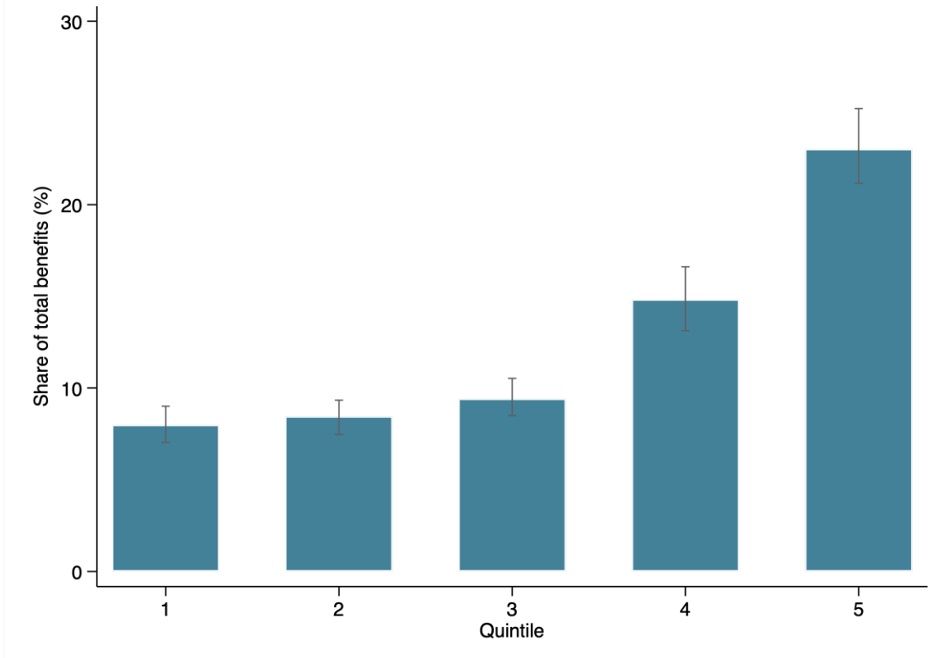
Source: Hoy et al. (2026), Figure 5(a). Quintile 1 is the poorest fifth and quintile 5 the richest. Bars show household shares, which sum to 64 percent; the remaining 36 percent was retained by stores and wholesalers. Error bars show bootstrap confidence intervals.
Differences in quantities purchased account for about two-thirds of the concentration of benefits among richer households; differences in pass-through across store types and locations account for the remaining third. Any analysis that ignores differential pass-through of food tax exemptions would miss a substantial part of the picture.
Experts did not see it coming, and households like it anyway
Before the results were in, we asked 237 experts, mostly economists and two-thirds of them in academia, to forecast pass-through and incidence through the Social Science Prediction Platform. They expected about half of the forgone revenue to be captured by stores, with the remainder spread fairly evenly across quintiles, if anything slightly favoring poorer households. They underestimated pass-through in competitive formal markets, overestimated it elsewhere, and did not anticipate how heavily the benefits would be concentrated at the top. If the people who study these policies for a living misjudged the outcome, it is not surprising that governments do too.
Households, meanwhile, like the policy. Asked in April 2026 how the government could best support poor and middle-class families, more than 70 percent of surveyed households ranked the VAT exemptions first or second among six options, about double the support for the next most popular choices, free textbooks and reducing government debt. In a survey experiment the following month, telling respondents that poorer households benefit less than richer ones, because the price cuts were concentrated in large urban supermarkets, lowered support somewhat. Information can shift some views, but evidence alone may not build a coalition for reform.
What this means for tax expenditure policy
Three lessons follow for anyone who designs, reports on or evaluates tax expenditures.
First, tax exemptions on food are poorly targeted in lower-income settings, which are characterized by subsistence production, high informality and segmented retail markets. In Papua New Guinea, these features, together with richer households purchasing more basic food (i.e., there are no inferior goods in these settings), concentrated consumer benefits among better-off households. These results illustrate how tax exemptions on food are inherently regressive and cannot be justified as an efficient way to support poorer households.
Second, the revenue forgone is a poor guide to the benefit delivered. Conducting microsimulations of tax reforms and applying the statutory tax cut to household expenditure data assumes full pass-through everywhere. In Papua New Guinea that would have credited consumers with the 36 percent retained by stores and wholesalers and overstated the share reaching the poor by ignoring the differential pass-through across store types and locations. Tax expenditure reviews should follow the forgone revenue all the way to its beneficiaries, using price data and household purchasing patterns to assess who actually benefits.
Third, there are much better instruments to achieve the intended results. An equal cash transfer to every household would put 20 percent of its payments in the hands of the poorest fifth, against the 8 percent they received from the exemption. It would deliver the same level of benefits as the VAT exemption for about 40 percent of the fiscal cost. Put differently, even an untargeted transfer generates roughly two and a half times as much value per fiscal dollar as the exemption. This is a simplified comparison, but it shows that even a poorly targeted social protection program is likely to be far more progressive than a VAT exemption.
The implications of this study extend well beyond Papua New Guinea. As Darío Tortarolo reported on this blog in August, more than 50 governments were implementing or considering food and fuel tax cuts in response to the 2026 oil shock. For food tax relief, the PNG evidence shows why governments need to establish whether benefits reach poorer households before extending or expanding exemptions.