

This policy insight was first published by the Center on Budget and Policy Priorities (CBPP)
Economic development shouldn’t compromise a state’s ability to collect revenue for essential services. In this year’s state legislative sessions, some states sought to end subsidies for data centers for reasons including the loss of revenue, a lack of community protections, increases in consumer energy costs, and environmental impacts. While a handful of states saw meaningful gains, only Maine managed to enact legislation repealing all available subsidies for data centers. Many states are facing tightening fiscal pressures, yet most still funnel public dollars toward already profitable technology companies. Next year, state lawmakers should do more to repeal these subsidies to protect needed revenue.
Forty states provide some sort of subsidy for data centers. The most common type is a sales tax exemption for the materials and technology purchased, either initially or on an ongoing basis. Some states also give data centers special rates for utilities, breaks for real property taxes, breaks for personal property taxes on equipment, or credits for corporate income taxes.
These subsidies are costing each of ten states over $100 million in lost annual revenue; annual losses in Texas and Virginia each top $1 billion. And at least 14 states don’t disclose the costs. In addition to the revenue loss, states must ameliorate data centers’ negative impacts on energy and water affordability, health, and the environment of host communities, which are disproportionately communities of color.
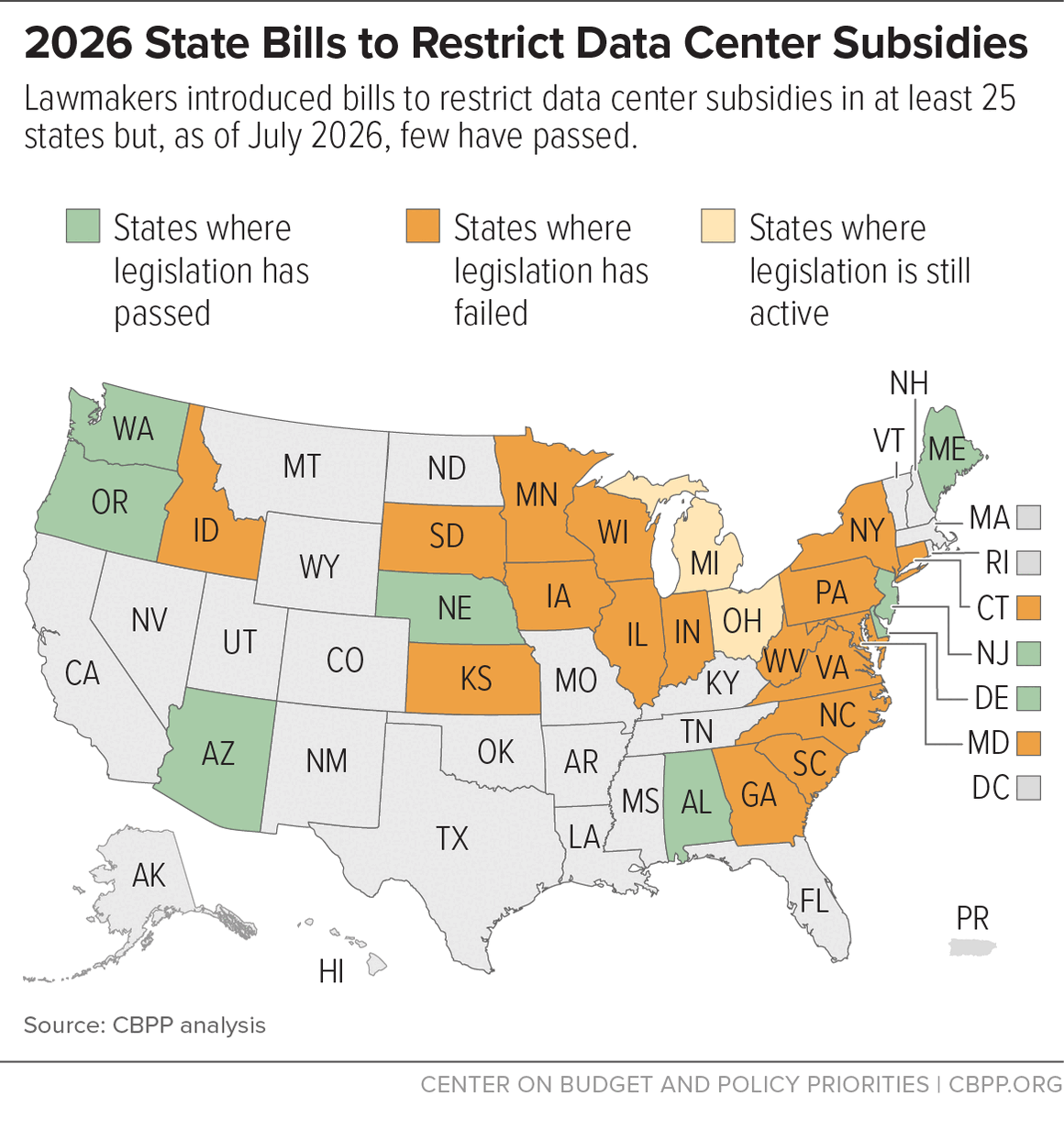
During 2026 sessions, lawmakers in some states began chipping away at subsidies for data centers — especially the large “hyperscale” data centers needed to run artificial intelligence and other large-scale machine learning programs. At least 25 states introduced bills to repeal or restrict data center tax subsidies, but such legislation passed in only eight states. Maine was the only state to enact legislation fully repealing all available tax subsidies. (See map.)
Additionally, governors in Illinois, Massachusetts, and Ohio paused their data center-specific tax subsidy programs and the governor of Nebraska blocked data centers from accessing subsidies through the state’s main business incentives program. These efforts are temporary and have less staying power than a legislative change, they may lay the groundwork for further action and give lawmakers time to catch up to the growing public concern about subsidizing data centers.
Legislation to scale back subsidies for data centers was considered and failed in the most recent legislation session in 17 states; while disappointing that more progress wasn’t made, the large number of states where legislation was considered points to growing concern about these subsidies and opportunities for building support going forward. One state where legislation failed is North Carolina, where what started as a data center subsidy repeal bill was rewritten – and remains under consideration – as a law that repeals property tax exemptions for solar energy. Legislation to reduce subsidies remains under consideration in two states.
In addition to attempting to curb data center tax subsidies, states this session also sought to address their negative impacts. Data center energy demand exacerbates already rising energy bills, their fossil fuel use ramps up air, climate, water, and noise pollution, and, their water use strains city services — especially in locations plagued by long-term drought. Legislators introduced over 300 bills in 41 states in 2026, almost double the volume of last year. Bills focused on improving energy grid stability and residential energy costs, adding transparency about data center deals and operations, and reducing harms to human health and the environment from data center water and energy use, among other issues.
Proponents of data center subsidies claim they support local economic development and can contribute to energy infrastructure buildout that benefits all users. But these potential benefits often are undermined by local tax subsidies on top of those at the state level and deals between data centers and utility regulators that happen outside of the public eye.
While states would ideally repeal all subsidies available for data centers, lawmakers can reform them to enhance transparency or control costs. Among the options that lawmakers have considered or passed:
- excluding local taxes from state exemptions (which is the case in Texas);
- tightening time limits for using subsidies (which Alabama did this year);
- pausing subsidies pending further study (which Oregon did this year);
- capping either total program cost, per-project subsidies, or subsidies for projects over a certain size (New York proposed the latter two this year);
- requiring reporting of per-project or aggregate lost revenue from subsidies (which Iowa proposed this year); and
- banning non-disclosure agreements covering any project receiving a subsidy (proposed in Minnesota this year).
States continue to subsidize data center development despite increasing public backlash and growing budget constraints, but there are signs that lawmakers are starting to re-think their approach to data centers. They have an opportunity to eliminate or reduce data center subsidies in next year’s legislative sessions.