


Bogotá is deliberating a local tax reform that would exempt new investment from its main business tax for a limited period, with the exemption declining year by year. Debates of this kind usually stop at comparing statutory rates or tallying the immediate revenue loss. This article sets out a transferable framework to go beyond this. The framework allows to estimate how much additional investment the exemption is likely to attract, how much revenue the city gives up while the exemption is in force, and what the balance between the two amounts would be, once it has expired. The procedure rests on embedding a subnational turnover tax into the cost of capital. The exercise was prepared by the technical team of the Secretaría Distrital de Desarrollo Económico, the economic development authority of the city government, which produced these estimates and led the design of the proposed incentives. The account that follows explains how the estimates were constructed and what they show.
A Local Problem Requires a Local Instrument
Investment debates gravitate towards interest rates, macroeconomic uncertainty and national tax reform. These are variables over which a city government exercises no control. Bogotá concentrates a substantial share of Colombia’s corporate, financial, and service activity and accounts for roughly a quarter of national GDP. Yet investment in productive capital has displayed persistent weakness, notwithstanding that leading position. Local tax policy is therefore one of few instruments available to the city to influence investment directly.
The reform under discussion seeks to use this lever. It contemplates an exemption from the Impuesto de Industria y Comercio (ICA) lasting up to ten years and declining year by year, available to new investments that exceed a minimum threshold in fixed assets within a defined set of strategic activities, together with partial and temporary exemption for established taxpayers that expand their activities. ICA is Bogotá’s main business tax and the city government’s largest source of locally raised revenue. It is charged on what a firm sells rather than on what it earns, at rates that vary by economic activity, which makes it the local counterpart of the turnover and gross receipts taxes levied by subnational governments elsewhere. This article develops a single framework to assess the trade-off between the exemption’s immediate fiscal cost and the investment, economic activity, and tax revenue it may generate over the longer term.
The Cost of Capital as a Basis for Estimation
The cost of capital, understood here as the full cost of putting an asset to work rather than the cost of finance alone, addresses a simple question: what minimum return must an investment generate to remain viable after tax? A firm acquiring machinery or building a plant faces costs beyond the purchase price of the asset. The capital committed to the investment carries an opportunity cost, the asset depreciates over time, and the applicable tax treatment must also be incorporated into the calculation. In this framework, the indicator therefore combines interest rates and economic depreciation with investment related tax discounts, VAT on capital goods and the effective incidence of corporate income tax and ICA. The resulting cost-of-capital indicator condenses these elements into a single reference rate that functions as a hurdle rate.
The Measurement Problem of Taxes Levied on Revenue Rather Than Profits
Applying the framework at city level raises a difficulty less common in national exercises. Subnational tax systems often rely on levies on revenue rather than profits, as is the case with Bogotá’s ICA. Its base compromises ordinary and extraordinary revenues, excluding items such as exports, sales of fixed assets, and revenues of excluded activities. Because ICA is levied on revenue, its incidence on profits depends on sectoral operating margins: at a given statutory rate, the tax represents a larger share of profits in lower-margin activities than in higher-margin ones. Disregarding this understates the tax’s effect on investment, particularly in capital-intensive sectors.
Incorporating ICA into the cost of capital therefore requires an additional step of approximation, and this is the core of the exercise. The procedure converts a tax on revenue into an effective burden on profits by combining two sources. District ICA collection statistics show how much is effectively paid, while sectoral operating margins constructed from national tax aggregates show how much profit each unit of revenue generates in each activity. Combining these inputs yields an effective ICA rate on profits, comparable to the corporate income tax and suitable for incorporation into the cost of investing in the city.
What the Estimates Show on the Benefit Side
The principal constraint at district level is the absence of consistent statistics on total private investment. The exercise therefore uses nominal FDI, the only investment series available on a continuous and comparable basis. This has an important limitation: FDI captures only the external component of investment and excludes domestically financed investment, which in Bogotá is the larger share. Since the reform changes the cost of capital faced by eligible investments regardless of their source of financing, domestic investment is expected to respond in the same direction, although the magnitude of that response cannot be estimated with the available data. The results should therefore be read as a conservative lower bound, not as an estimate of the aggregate impact of the reform. The analysis proceeds in two steps, first estimating how the incentive affects the cost of capital and then how investment responds to that change.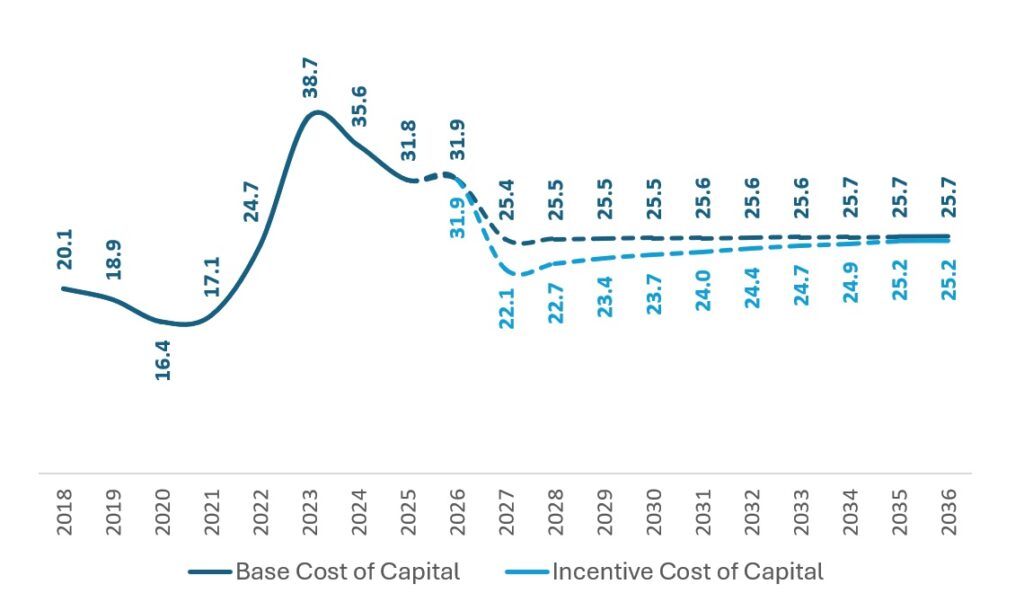
Figure 1. Nominal cost of capital for new investment in Bogotá (% of invested capital). Baseline scenario and ICA tax incentive. Source: DEDE and SDDE.
The nominal cost of capital in Bogotá increased sharply from 2022, peaking near 39 per cent in 2023 under the monetary tightening cycle and a heavier tax incidence on corporate profits (Figure 1). It declined thereafter but remains elevated, at around 26 per cent (absent incentives). Against this baseline, the proposed ICA exemption lowers the cost of capital over its ten-year duration, with the size of the benefit contingent on the amount invested (Figure 1). The exemption is most generous in the early years and gradually converges towards a marginal benefit by the end of the period. The resulting reduction in the cost of capital persists over the life of the exemption, allowing more projects to meet the required return.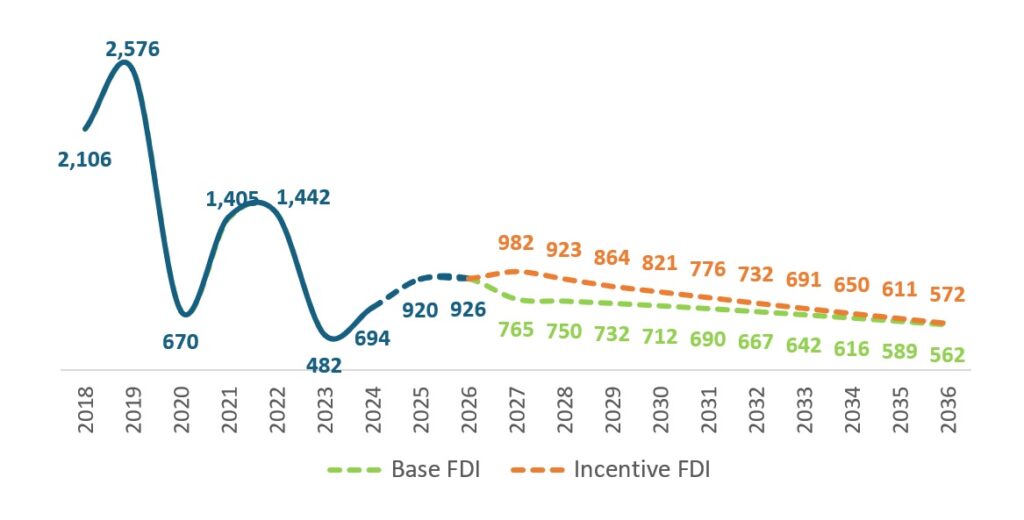
Figure 2. New foreign direct investment in Bogotá (USD million). Baseline scenario and scenario with ICA tax incentives. Source.:DEDE and SDDE, based on Invest in Bogotá figures.
As shown in Figure 2, projected FDI is higher under the incentive scheme than under a baseline, with the cumulative difference widening over time (reflecting the persistent effect of a lower required return), and reaching roughly USD 900 million in additional FDI over ten years. The effect is most pronounced early on, when the reduction in the cost of capital weighs most heavily on location decisions and gradually diminishes as the exemptions are exhausted. This is not a prediction that the additional investment will necessarily materialise, but an estimate of the investment response generated through the reduction in the cost of capital.
The Fiscal Side and the Timing of Revenue
The same framework also estimates the fiscal effect of the incentive, allowing the investment benefits and fiscal costs of the incentive to be assessed using a common set of assumptions. The fiscal impact is neither immediate nor uniform. In the early years, new investments are assumed to still be under development and therefore generate little taxable revenue of their own. Once they begin to operate, revenue would fall below baseline, most sharply at first and less so as the exemption tapers and the base widens.
In aggregate, the revenue forgone while the exemption is in force is expected to accumulate to COP 195 billion. Once the exemption expires, the firms attracted by the incentive are assumed to remain in the city and pay ICA at full rates, generating around COP 298 billion in additional revenue relative to the baseline. Over fifteen years this implies a net fiscal gain of approximately COP 104 billion for the city.
Lessons for Local Tax Incentives
Tax incentives can better be assessed when their benefits and fiscal costs are estimated through their impact on the cost of investing, rather than inferred from comparisons of statutory rates or from the immediate revenue effect alone. Applied to a real reform, the cost of capital approach makes it possible to estimate by how much an exemption lowers the required return on investment and how many additional projects may consequently become viable. Estimating this effect can also sharpen the targeting of incentives, since it clarifies which minimum investment and which activities justify preferential treatment, and for how long.
The approach can also be applied in any city with access to interest rate series, local collection statistics, sectoral operating margins and some indicators of investment flows, a demanding but attainable set of inputs for most subnational administrations. It offers a way to estimate the benefits and the fiscal costs of a tax expenditure within one framework, and to move a local debate from intuition towards evidence.
The framework nevertheless has important limitations. The investment response is estimated from a relatively short FDI series, so the resulting elasticities should be interpreted as plausible orders of magnitude rather than as causal estimates or precise forecasts. FDI also captures only the external component of investment, while the incidence of ICA on profits is approximated using district tax data and sectoral operating margins derived from national aggregates.
The projected fiscal gains should therefore be interpreted with similar caution. They depend on the additional investment induced by the incentive actually being realized and remaining in the city, and on the assumptions used to translate that investment into future tax revenue. Sensitivity analysis and ex post evaluation are therefore important complements to the framework.